
Nations’ hands clench in fists of rage on behalf of people’s will. And the flowers never bend with the rainfall off the massive wall. Wall of the Word, the law, the oppression. While on its sides – the art, the people, the favela. The Tropicália Movement. Brazil. Hélio Oiticica. His radically vibrant world.
The History
Dating back to the 19th century, French philosopher Auguste Comte created his credo: “Love as a principle, Order as the basis, Progress as the end“. – Love, instead of selfishness and personal interest solely. His idea of shaping society consisted of altruism within rationality guiding humankind.
The new Brazilian republic had its own need for ideological establishment in the same period. This task was taken up by intellectuals and political leaders who would have to comprise the new image of the state. They would establish new values, new beliefs – ones supposed to differ from the past where violence and feudal power ruled.
In the early days of the new Brazilian republic, their leader Raimundo Teixeira Mendes – inspired by Comte’s Positivist philosophy of sense, logic and order – designed the present flag of the country, featuring the motto “Ordem e Progresso” (Order and Progress).
The principle of “Love” (a primary notion in Comte’s belief) was not included in the motto. Both the country’s leaders and influential thinkers of the time argued that this new state should be guided by seriousness in order for the future to be prosperous. The concept of love just didn’t seem to fit in this new governance form.
On the other hand, not knowing whether the leaders were surprised, people would face harsh consequences. Reasons explaining this could be traced back to the lack of altruistic values and engagement with citizens’ welfare, with the politics of equality. To this day, Brazil remains one of the countries with the largest income inequality: the continuous inadequacy of governmental operations in the past century left a mark on the country. Over time, slums, better known as “favelas” would emerge in Brazilian cities marking lives with difficulties.
A historical moment in the history of the country was the transformation to the republic, where the new power would be rather underlined by militarism and strict control. An example that showed the authoritarianist side of the republic emerged in 1964, when a coup, backed by the United States, ended with an openly right-wing government taking the power in the country. Leadership characterized by oppression towards people’s needs, spreading police violence across protests, would fill the atmosphere.
The Artist
One artist, named Hélio Oiticica, noticed what was going on in the country. Born into a cultured upper-middle class family, Oiticica grew up being socially aware of the oppression, inequality and the multiple forms of injustice happening around him.

Hélio Oticica, 1960s
He would see the culture of his country as multicolored, and carefully crafted his movement through the art he created. Pieces full of satire, challenging stereotypes and hinting revolution would emerge in Brazil during the 1960s. They would continue to inspire to this day, to embrace the truth through the multilayered perspective of the Tropicália.
The Art and the Movement
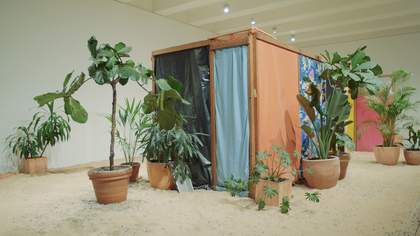
Oiticica’s craft involved art installations consisting of wooden structures accompanied by various types of tropical plants all over them. A mission of the artist would be to transcend a message through what left an artistic impression on him growing up as a socially aware Brazilian.

The Tropicália, Image from ‘Artsy’
Certainly, the meaning of the movement can be seen through more than a singular lens. On the one hand, the satire of the stereotype which portraits Brazil as a tropical paradise is noticeable. After all, his creation is not random. The wooden structures’ representation is not to be missed.
This is where the second layer comes in. Oiticica, as the excellent artist he was, was able to do more than simply a material installation: he would craft worlds, serving as a portrait of the poverty and instability emerging in Brazil as a reaction to the militarist government – an organ of power, where the word “Love”, coined as a main principle by Comte, remains long-forgotten. Non-existent, even in the face of the country’s flag – perhaps a state’s main symbol.
The Tropicália serves as an individual expression, yet one so powerful that it can be used as a lens to observe the general in the particular. Though, Oiticica has always aimed for a product, belonging to the observers themselves. The spaces he would craft would always be attended closely by multiple visitors.

Visitors of Tropicália
Impacting Emotions, Impacting Society
One could sit in the sand of the installations, try to look through the window or to feel the satin curtain. Art reflects the individual’s personality showing their social perspective.
Thus, every visitor could feel the favela and the political irony, even how shallow the image of a state seems.
And then one could also feel the reaction – either to oppression, or simply to society. Hiding in a wooden construction, or being a colorful greenery. Or perhaps the lost principle of Love, long-forgotten behind layers of Order… Supposedly, even leading to an impression so personal, encoded solely by one’s own mind.

Tropicália visitors in the 21st century

The Tropicália, image from Tate, UK
References:
Comte, A. (1877). System of positive polity: Theory of the future of man, with an appendix consisting of early essays on social philosophy.
Mills, C. W. (1959). The sociological imagination. The Mississippi Valley Historical Review, 46(2), 355. https://doi.org/10.2307/1891592
Tate, UK
Project OHO
https://projetoho.com.br/en/ho-project/
Irish Times
Images:
Hélio Oiticica, 1960s
https://encrypted-tbn0.gstatic.com/images?q=tbn:ANd9GcR5-ITYZe-gKKVodE2eRPkpT6PzQ3JaUuHAWA&s
The Tropicália, Image from ‘Artsy’

Visitors of Tropicália
https://www.diatomea.net/wp-content/uploads/2021/04/5-1024×615.jpg

Tropicália Visitors in the 21st century
https://projetoho.com.br/en/ho-project/
The Tropicália, Image from Tate, UK